The Last Mile Lens featuring Matthew Hertz, Founder of Third Person – PART 2
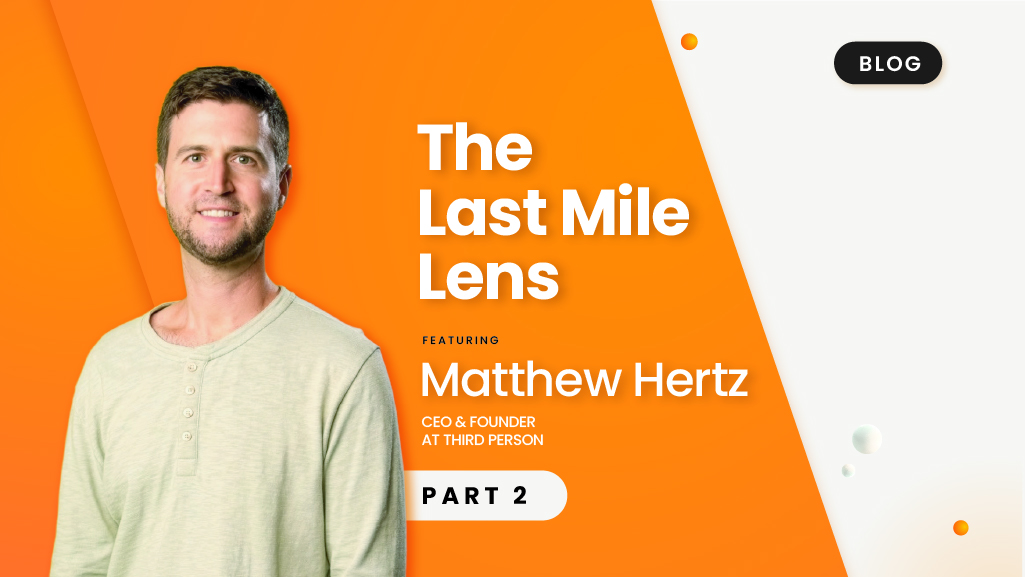
Conversations with the leaders transforming e-commerce, logistics, and the supply chain.
So you’ve chosen a last-mile partner. Now what? The selection process isn’t painless, but the real challenges begin once orders start moving and real-world variables of package handoffs, customer expectations, delivery exceptions, and day-to-day performance come into play.
In part two of our conversation with Matt Hertz, founder of Third Person, we look beyond the selection process to what actually determines whether a last-mile partnership succeeds.
With more than 15 years of experience working at the intersection of brands and logistics providers, he’s seen firsthand how quickly even promising partnerships can unravel without the right metrics, communication, and operational alignment. From the delivery metrics brands tend to overemphasize to the operational breakdowns that occur after contracts are signed, Matt shares what separates the strongest last-mile relationships from those that struggle.
Which last-mile metrics do you see overemphasized, and which ones are often overlooked but more telling long term?
Matt: Average transit time is often overemphasized. And I’m guilty of focusing on it myself. I often ask what the average transit time looks like assuming a typical e-commerce distribution.
But we all know that averages are good at masking all the sins of an operation. If 90% of packages arrive within two days but 10% take ten days, the average might still look pretty good. But now you have 10% of customers who are likely to stop shopping with that brand.
One metric that deserves more attention is time to first scan. So, when a brand processes and ships an order, how long does it take for that package to get into the carrier’s hands?
Every 3PL handles this a little differently. Some use what’s known as front-end labeling. So, at 8 a.m., when the warehouse opens, they start batching orders and printing labels, even though an order might not be fulfilled until 6 p.m. If the daily carrier pickup already happened, that package won’t leave the facility until the next day, even though it was technically marked as shipped.
Another overlooked metric is the WISMO rate. Efficiency isn’t the only thing that matters. If a carrier saves me a dollar per order but generates three times the number of WISMO tickets or customer service issues, there’s a real cost to that. Brands and 3PLs need to track this.
Where do last-mile partnerships most commonly break down after contracts are signed?
Matt: At the infamous sales-to-ops handoff. The sales team closes the deal and promises the world. Then the operations team or account manager who has to deliver for the client looks at it and thinks, ‘Wait, we can’t actually do that.’ This is where the breakdown begins, where the proactive communication often ends, and where the partnership turns into a blame game.
The carrier might say it was a bad or incomplete address. The brand says they’ve always shipped there with another carrier, so it must have been a bad driver. Without a single source of truth and clean, reliable data, the partnership can become adversarial pretty quickly.
Volume expectations also create problems. During the RFP process, a brand might say they’re shipping 10,000 packages a week, but once service begins, they’re actually closer to 3,000. The opposite can happen, too, both of which are difficult for any operations team to absorb.
Ultimately, the strongest partnerships come down to communication, good data, and honesty.
If a brand or 3PL is rethinking its last-mile strategy today, what’s one internal question they should pressure-test before engaging providers?
Matt: The key internal question is: What are we actually optimizing for? Is it cost, or customer experience and lifetime value? Ideally, a brand finds partners who can deliver on both.
But in reality, if they’re primarily solving for cost, they’ll likely choose one set of carriers and accept a few more operational headaches along the way. If they’re optimizing for lifetime value, they may be willing to pay more for a carrier that offers exceptional service.
Increasingly, alternative carriers are differentiating themselves with better technology, things like real-time tracking once a package is out for delivery, similar to the Uber or DoorDash experience, where you can see exactly where the driver is. Brands may also value features like photo proof of delivery or more professional delivery experiences. Ultimately, it comes down to being clear internally about where you fall on that optimization spectrum before engaging providers.
Check out Part 1 of The Last Mile Lens with Matt Hertz, where he shares how brands should evaluate last-mile providers and structure pilots to reveal actual network performance.
Explore more insights in The Last Mile Lens series, where we sit down with leaders shaping the future of e-commerce, logistics, and supply chain. As always, reach out to learn more about our last mile delivery offerings to hello@uniuni.com.